Pattern Reading · Jacks & Streams
How to Read Jacks, Chordjacks & Streams
When notes start flying at 20+ KPS, your eyes cannot track every single arrow individually. Reading fast is about eye placement, chunking shapes, and keeping your hands calm.
1. Stop staring directly at the receptors
Beginners glue their eyes to the hit bar at the bottom (or top on upscroll). By the time you see a chordjack on the receptors, it is already too late to react.
- Rest your eyes around the middle third of the playfield and use peripheral vision for the receptors.
- Use a clean, high-contrast skin (circle or bar notes with zero flashing clutter) so shapes jump out instantly. Check my osu!mania skins here.
2. Read shapes (chunks), not single notes
Top 4K players do not think "left, up, down, right." They recognize recurring geometric shapes in one glance:
- Jumpstreams & Handstreams: anchor your rhythm on the 2-note or 3-note chords (they usually sit on the main beat) and let the single notes fill the gaps between them.
- Chordjacks: read the empty lane on 3-note hands instead of counting the 3 notes. Seeing which 1 finger stays up is way faster than finding which 3 fingers go down.
3. Mini-jacks vs. long jacks
A 2-note or 3-note mini-jack uses quick finger bounce; a long dense jack stream uses controlled wrist-arm motion. Mixing the two techniques is why players lock up mid-song.
- Practice chordjack charts at 0.9x speed first so your hands learn to hit all notes in a chord cleanly together without flaming or double-tapping early.
- If you mindblock on a section, stop retrying it 10 times in a row. Flip Mirror on or move to a different chart and come back tomorrow.
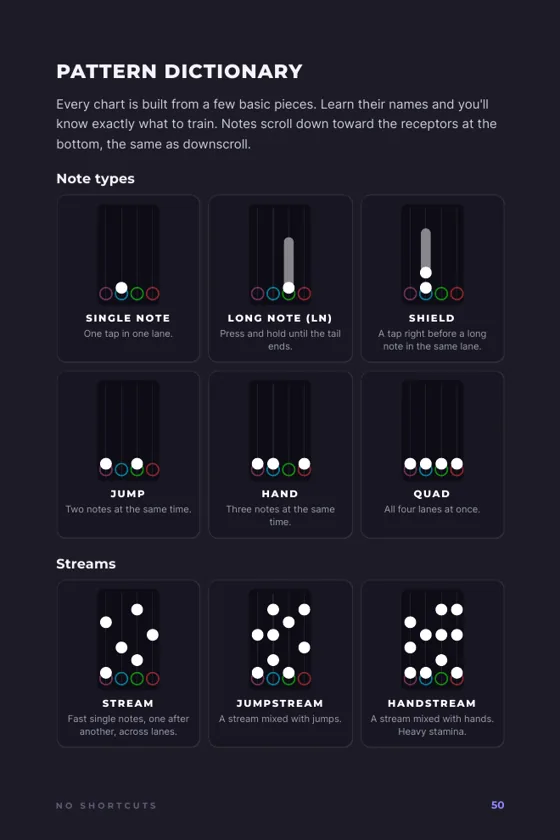
Visual Pattern Breakdown · No Shortcuts
See every 4K pattern broken down visually
In No Shortcuts, I break down streams, jumpstreams, handstreams, chordjacks, vibro, and LN patterns with clean diagrams and exact song recommendations to practice each one.